Butcher jobs in Australia for Pakistani workers: sponsored routes and the proof to prepare first
Tips · 2026-10-29 · 10 min read
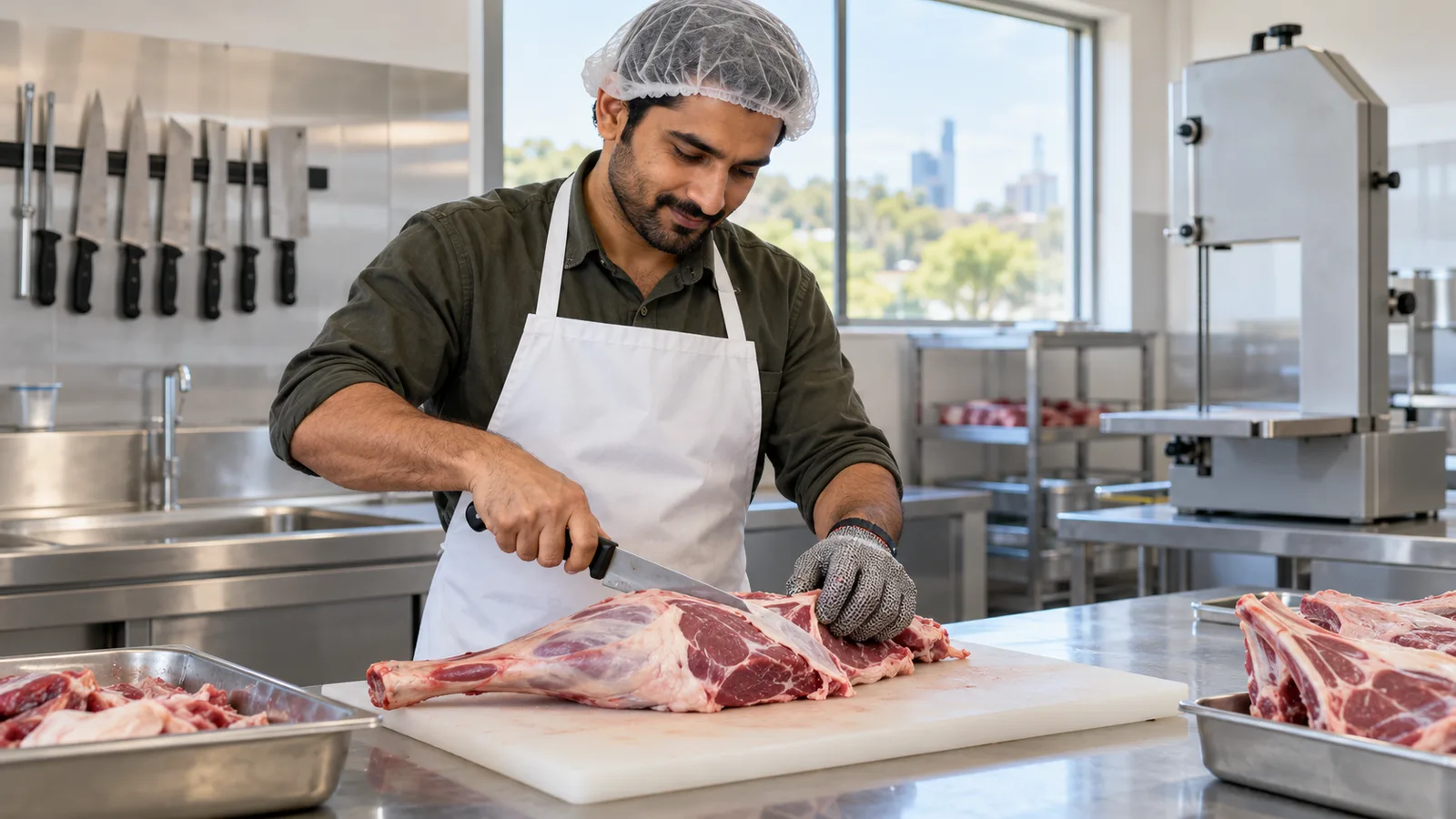
Butcher jobs in Australia for Pakistani workers are usually filled through employer sponsorship: an Australian business that cannot find a suitably skilled local worker nominates you, often under the Skills in Demand visa (subclass 482) or a meat industry labour agreement. Your chances depend less on where you trained and more on how well you can prove your experience. This guide sets out the routes in general terms and the papers to prepare in Pakistan before you apply.
How sponsored meat industry jobs work
An Australian employer that wants to hire you from Pakistan has to sponsor you. Home Affairs describes the 482 as a temporary visa that lets an employer sponsor a suitably skilled worker for a position it cannot fill with a suitably skilled Australian.
That has a practical meaning for you. You do not apply for "a butcher visa" on your own: you apply for a job, and the employer's nomination carries the visa. If you want the employer's view of why some meatworks wait longer than others, read our briefing on priority tiers and remote abattoirs in Western Australia.
Meat work also covers more than one job. A retail butcher cuts and prepares meat for customers in a shop. Processing work in an abattoir or boning room is a different set of tasks, and an employer will read your letters to see which one you actually did.
The community already does this kind of work. In the 2021 Census, 3,410 employed Pakistan-born people in Australia (7.3%) worked as Technicians and Trades Workers and 2,794 (6.0%) as Labourers.
The sponsored routes, side by side
These are the main employer routes in general terms. Which one fits a particular job is decided by the employer, its nomination and Home Affairs, not by you.
| Route | What it is | What it usually asks of you |
|---|---|---|
| 482 Core Skills stream | Temporary visa; the employer nominates an occupation on the Core Skills Occupation List | At least 1 year of relevant experience in the last 5 years; a skills assessment for some occupations; English test results |
| Labour agreement (482, 186 or 494) | An agreement between the Australian Government and the employer; meat and pork are among the ten industry labour agreements | The terms of that agreement, which your employer works under |
| Designated Area Migration Agreement (DAMA) | A regional agreement with a state, territory or regional authority that opens more occupations | The employer must first show a genuine attempt to recruit Australians |
| 494 regional visa | Five years living, working and studying in designated regional areas | At least 3 years of relevant experience, a relevant skills assessment and an age under 45, unless exemptions apply |
Labour agreements are generally in effect for five years and can be used for the 482, 186 and 494 visas (Home Affairs: types of labour agreements). Many meatworks sit outside the big cities, and that matters for the 494: its designated regional areas include all of Australia except Sydney, Melbourne and Brisbane.
For the full 482 requirements in one place, see our guide to the Australia work visa from Pakistan: the Skills in Demand (482) visa.
Pay and the 2026-27 settings
In the 482 Core Skills stream, the worker must be paid the Annual Market Salary Rate for the occupation and no less than the Core Skills Income Threshold (CSIT). For nominations lodged between 1 July 2026 and 30 June 2027, the CSIT is AUD79,423.
As a rough comparison only, that is about Rs. 15,300,000 a year at the State Bank of Pakistan's ready rate of 193.0839 rupees per Australian dollar on its mark-to-market sheet for 7-Oct-26. Exchange rates change, so recalculate on the day you compare offers.
The 2026-27 program year, which began on 1 July 2026, also has more room for employer-sponsored workers: the Employer-Sponsored planning level is 58,040 places, up from 44,000 in 2025-26. Planning levels are not job offers, but they show where the program is set this year.
Experience proof to prepare in Pakistan
Your experience letters do most of the work. MOFA attests experience certificates only when they are on the letter pad of the institute or department, with the named seal and signature of the Head of Human Resources (its consular attestation rules).
MOFA's list names the first attesting body for some trades, such as NAVTTC or NTB for electricians and mechanics and PTDC for cooks and chefs. It does not name butchers, so ask MOFA before you queue anywhere. Our guide to experience certificate attestation in Pakistan explains how to handle a trade with no row.
A strong letter for meat work states:
- your exact job title and the start and end dates, month and year;
- full-time or part-time hours (part-time or casual work must add up to at least 12 months full-time for the 482);
- the tasks you did: breaking carcasses, boning, slicing, trimming, preparing cuts for sale, cleaning and sanitising;
- the tools and machines you used, such as band saws, mincers and slicers;
- whether you worked in a shop, a processing plant or a hotel kitchen, and the animals you handled.
If your work included halal slaughter or halal preparation, describe it plainly and exactly as you did it. Ask for salary slips too: they back up the dates on each letter.
Many Pakistani butchers have worked in the Gulf. The proof works the same way from there, and JobsAbroad Bangladesh's guide to turning Gulf experience into proof for an Australia job shows how to collect it.
To see what an Australian employer expects a qualified retail butcher to do, compare your duties with the units of the Certificate III in Meat Processing (Retail Butcher) on RPLDirect. It is a useful checklist when you write your letters and CV, not a promise of a job or a visa.
Step by step: from Pakistan to a sponsored meat job
- Look up butcher and meat worker occupations on the combined list of eligible skilled occupations. It shows the list each occupation is on and its skills assessing authority.
- Collect an experience letter from every employer, in Pakistan and abroad, on letterhead with the HR head's named seal and signature, plus salary slips.
- Ask MOFA which body attests a butcher's experience certificate first, then get the attestation done. MOFA charges no fee for attestation, only prescribed revenue stamps.
- Take an English test at a test centre if the job or visa needs one. Our guide to choosing IELTS or PTE for Australia compares the two.
- Write an English CV with every job's dates, duties and the machines you used. Build AI CV helps you lay out each meat job clearly.
- Apply only to employers prepared to sponsor, such as the openings in our manufacturing jobs section, and prepare for a video interview with our video interview plan.
- When an offer arrives, read it line by line before you sign: our checklist of 8 lines to check in a job offer letter helps.
- If a skills assessment is required, start it before the visa application is lodged. Then arrange police certificates and health examinations.
- Before you leave, appear before the Protector of Emigrants, as section 15 of the Emigration Ordinance, 1979 requires.
English, police and health papers
For the 482 Core Skills stream, the IELTS minimum is 5.0 in each of listening, reading, writing and speaking, and the PTE Academic minimum is Listening 33, Reading 36, Writing 29 and Speaking 24 (tests taken on or after 13 September 2025). The test must be taken within 3 years before applying.
Home Affairs may ask for a police certificate from every country where you lived for at least 12 months in the past 10 years, usually if you were over 17. Police certificates for Australian visas are valid for 12 months. In Punjab, a Police Character Certificate is applied for at a Police Khidmat Markaz for Rs. 350 and takes 3 working days; Islamabad Police charges Rs. 1000.
Home Affairs lists Pakistan among the polio countries of risk, so keep proof of an inactivated polio vaccine (IPV) dose within 12 months of travel if the visa officer asks for it.
Common mistakes Pakistani meat workers make
- Letters without the right seal. A handwritten note from a shop owner, or a letter without the HR head's named seal and signature, will not be attested by MOFA.
- Vague duties. "Worked as butcher" says nothing. Name the cuts, the machines and the setting, because an employer has to match you to its role.
- Leaving the skills assessment too late. Where it is mandatory, it must be started before the visa is lodged, or the application is not valid.
- Paying for a job or sponsorship. It is illegal in Australia, and the 482 requires that you have not paid for sponsorship in the past 3 years. See our guide on what to check before handing over cash.
- An at-home English test. Home Affairs does not accept tests delivered entirely online, such as IELTS Online.
- Leaving without Protector Clearance. Departing other than under the Emigration Ordinance can mean up to five years in prison and a fine of up to one million rupees.
Frequently asked questions
Is butcher on Australia's skilled occupation list?
Check it yourself on the Home Affairs combined list of eligible skilled occupations. It shows whether an occupation is on the Core Skills Occupation List (CSOL) or another list and names the assessing authority, so you can see exactly where a butcher or meat worker role stands before you apply.
Can I get a butcher job in Australia without a skills assessment?
It depends on the occupation and the visa. Home Affairs says some primary 482 applicants must have a mandatory skills assessment by Trades Recognition Australia or VETASSESS, and it must be started before the visa application is lodged. Your employer or a registered migration agent can confirm whether it applies to your nominated job.
How much experience do I need for a sponsored butcher job?
For the 482 visa, Home Affairs asks for at least 1 year of relevant work experience in the nominated occupation or a related field, gained within the last 5 years. The 494 regional visa and the 186 Direct Entry stream usually ask for at least 3 years, so longer experience opens more routes.
Does my butcher experience in Saudi Arabia or the UAE count?
Relevant experience abroad can be part of your record, so ask each Gulf employer for a letter with your dates, duties and the work you did. If you lived in a Gulf country long enough, a police certificate from that country may be needed alongside your Pakistani one.
Should I pay someone to arrange a meat industry job in Australia?
No. It is illegal in Australia to pay an employer to sponsor you, including through salary deductions, and it can lead to visa refusal or cancellation. In Pakistan, anyone who is not a licensed OEP and takes money for foreign employment can face up to fourteen years in prison.
Key takeaways
- Butcher and meat worker jobs in Australia come through employer sponsorship: the 482, labour agreements (meat is one of the industry agreements), DAMAs and the regional 494.
- Check your occupation and its assessing authority on the Home Affairs combined list before you apply.
- Detailed experience letters on letterhead, with the HR head's named seal and signature, are your strongest evidence.
- Start any required skills assessment before the visa is lodged, and keep your English and police papers in date.
- Never pay for a job or sponsorship, and appear before the Protector of Emigrants before you leave.
#butcher jobs #meat processing #pakistan #australia #skills assessment #experience letters
 Paying money for a job abroad? What Pakistani applicants should check before handing over cash
 IELTS or PTE for Australia from Pakistan: how to pick based on your English skills
 FIA complaint against a fake agent: the evidence, numbers and steps Pakistani workers need